
Optimisation in the course of time
IVU uses state-of-the-art optimisation algorithms and has been able to draw on the expertise of the renowned Zuse Institute Berlin (ZIB) during the development of these mathematical optimisation methods. This makes it possible to quickly cre ate duty and vehicle working schedules that fulfil all legal and operational requirements. In this interview, Dr Andreas Löbel (IVU) and Prof. Dr Ralf Borndörfer (FU Berlin and Zuse Institute Berlin) discuss the future of optimisation in public transport.
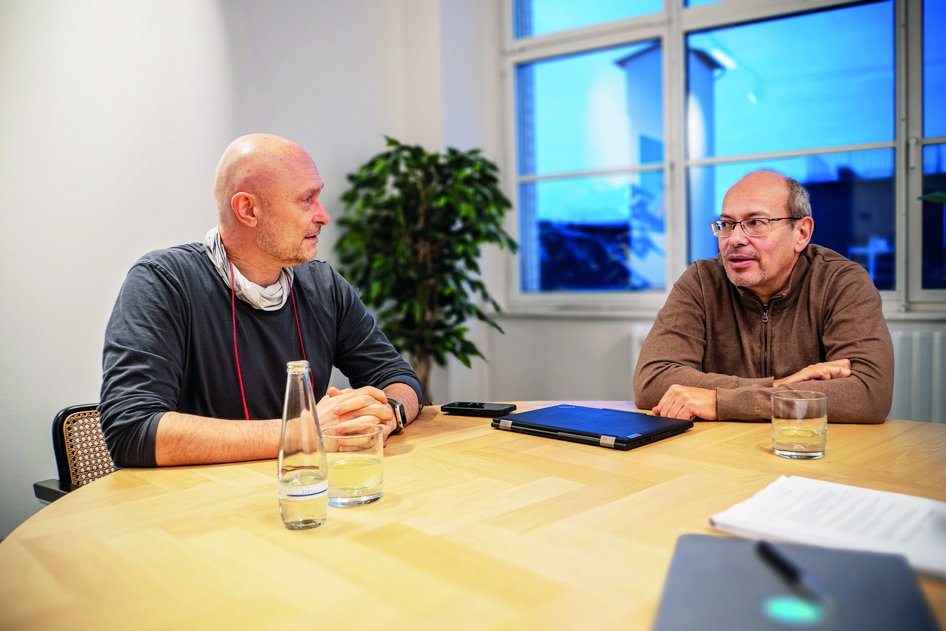
The successful cooperation between IVU Traffic Technol ogies and the Zuse Institute Berlin in the development of intelligent algorithms for optimisation has now been in place for many years. How did this co-operation orig inally come about? Which topics were at the centre of attention at the beginning?
LÖBEL: Ralf and I studied together in Augsburg and were taught by Prof Martin Grötschel. We have always been in terested in how maths can influence and improve the real world. When Prof Grötschel moved to the Zuse Institute in Berlin in 1991, he also focussed on traffic. After complet ing our diploma thesis, we followed him to the institute in 1992. One of our first tasks was to develop a vehicle working schedule for the Telebus – a bus system for people with re stricted mobility in Berlin.
BORNDÖRFER: Right from the start, our aim was to devel op algorithms that would improve public transport. It was particularly important to us that the planning results were directly applicable without having to make any additional adjustments.
LÖBEL: At the time, IVU had a customer with very specific requirements for an optimisation system for vehicle work ing scheduling. That was the beginning of our collaboration and the development of a close partnership that has now been successful for around 30 years. The first customer was followed by further projects, including optimisations for vehicle working scheduling and duty scheduling for bus and rail customers.
How have the requirements of transport companies changed over the last 20 years?
LÖBEL: Over the years, the focus of optimisation has changed significantly. In the past, the main focus was on reducing the use of resources in order to achieve the same or even better output at the lowest possible cost. This pri marily involved the more efficient utilisation of vehicles and personnel. Today, the shortage of skilled labour poses a completely new challenge: the limited capacities must be planned in such a way that transport continues to function stably and offers drivers attractive services for a long-term commitment. This issue will become even more important in the coming years, as many employees are retiring and it is likely to be difficult to recruit enough new staff.
BORNDÖFRER: The tasks have become more complex and the requirements for optimisation have become much more detailed. At the beginning of the 2000s, we started optimising the circulation of classic diesel buses for trans port companies. The complexity has increased with the op timisation of railway companies and reached a new peak with the use of electric buses.
Keyword e-mobility on the road: what are the chal lenges in optimising electric buses?
LÖBEL: The scheduling of electric buses is extremely complex. In contrast to diesel buses, which start with a full tank, are in use all day and only return to the de pot in the evening, electric buses have to be recharged 22 more frequently. Their range depends on many fac tors, such as battery condition, weather conditions and vehicle utilisation. Initially, we tried to adapt one of our tried-and-tested planning procedures. However, this did not work for various reasons. In the end, we were able to benefit from other problems relating to ser vices and thus develop algorithms for optimising the scheduling of e-buses.
We live in the age of artificial intelligence (AI) – pro vocatively asked: can AI take over the entire optimi sation process?
LÖBEL: Artificial intelligence and optimisation should not be seen as opposites. All AI processes are essen tially optimisation, and conversely, AI can obtain the in formation needed for optimisation in a comprehensive manner. If the question is whether all problems can be solved effortlessly with a single method, then the an swer is no, "there is no free lunch". You still have to use the appropriate method in each case. But with AI, the spectrum of possibilities expands. For example, you could use machine learning to automate very detailed parameter recording for vehicle circulation planning. However, the actual planning will still be carried out using integer optimisation in order to achieve the same quality of results.
BORNDÖRFER: AI is usually divided into three areas: descriptive, predictive and prescriptive. Descriptive AI analyses data in order to understand what is going on. Predictive AI attempts to predict the future on this ba sis. Prescriptive AI uses this information and forecasts to make decisions. This is exactly what optimisation does. AI and optimisation are therefore not opposites, but complement each other.
What topics do you think the transport industry will be dealing with in the next five to ten years and how can applied maths support this?
LÖBEL: Over the next five to ten years, the transport industry will increasingly benefit from the availability and utilisation of large amounts of data. This data will make it possible to significantly extend the planning ho rizon. While planning to date – with the exception of train planning – has mostly been carried out on a daily basis, mathematical algorithms will soon be able to enable cyclical, integrated vehicle working and duty schedul ing, for example for electric buses, for an entire weekly period.
BORNDÖRFER: In the future, predictions will be possi ble in "true" real time, and intermodally. However, this is not always easy. Let's take the example of a park & ride terminal: if a free parking space displayed on departure is no longer available on arrival, this leads to frustration. The same applies to local transport if, for example, suggestions from planning systems can not be used during disruptions or major events such as football matches. Thanks to ever more comprehen sive data and improved control options, we will be able to better control transport systems in real time and organise them intermodally. This will significantly in crease the efficiency and reliability of transport.
Optimisation has always been an interplay of algorithms and computing power. What opportunities do quantum computers offer?
BORNDÖRFER: Quantum computing is a fascinating re search topic with great potential. Algorithms already exist for certain problems that could run much faster on quan tum computers. However, we still face technical challeng es, such as susceptibility to errors and the handling of input and output. In the short term, we should not expect any ‘quantum leaps’ in the transport sector, but in the long term, quantum computers could offer revolutionary oppor tunities. However, it will be years before we see practical applications.
We look forward to hearing from you
Do you want to talk with a customer advisor or learn more about career opportunities with us? Or maybe there is something else you want to talk to us about? Write to us – your contact person will get back in touch with you as quickly as possible.
IVU Traffic Technologies AG
Headquarters
Bundesallee 88
12161 Berlin, Germany
Phone: +49.30.8 59 06 -0
E-mail: contact@ivu.com
Stay up to date – receive news about our projects, customers, and products directly in your inbox.