
Intelligent depot and charging management at ESWE
Implementing electromobility takes more than just purchasing new e-buses. It requires foresight, team spirit, and digital tools in the background. ESWE Verkehrsgesellschaft mbH in Wiesbaden shows what is needed if change is to take place on more than just paper. In an interview with Managing Director Marion Hebding, we find out how this is achieved and what role integrated depot and charging management plays in this.
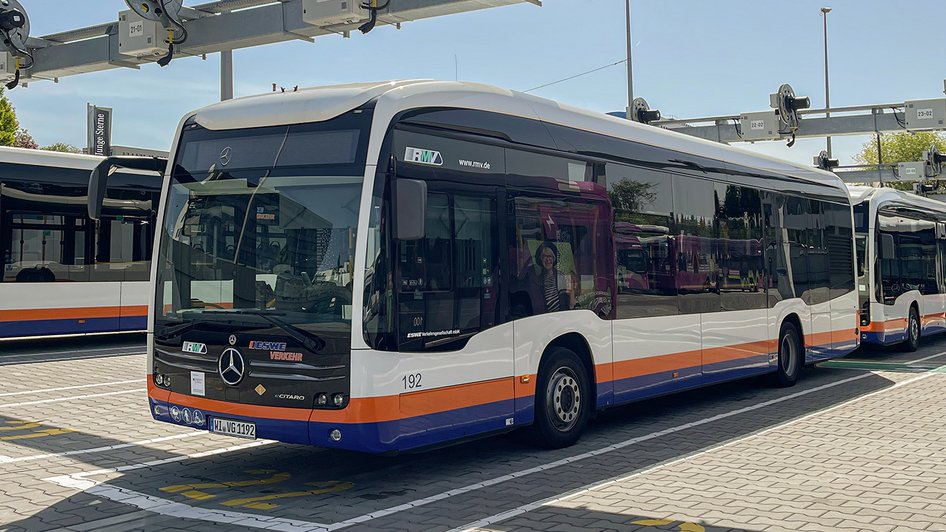
Electromobility not only means a change in technology – it changes entire operating proces ses. Why is the switch to e-mobility so central to ESWE Verkehr and how are you shaping this transformation process in concrete terms?
For ESWE Verkehr, the switch to electromobility is an integral part of our company's strategy. As a municipal transport company, we are adopting an exemplary role for the state capital Wiesbaden and making a central contribution to the urban climate and sustainability goals.
For quiet and emission-free public transport, we are combining the expansion of the charging in frastructure with a forward-looking depot concept and consistent further development of our opera ting processes.
For this transformation to succeed, we need highly trained employees and transparency about what is happening in the company and the situation in the depot so that we can organise the change step by step while keeping an eye on daily operations.
The interaction between charge scheduling, vehicle dispatch, and operational deployment is complex. What support does IVU's integrated depot and charging management system provide to seamlessly control these workflows?
The integrated depot and charging management system is the central control centre for our daily operations management. The system combines charging requirements, vehicle working schedu ling, and vehicle availability. This makes it possible to precisely control which vehicle charges when and where – tailored to its range, vehicle type, and the current network load. The software automati cally suggests suitable charging windows and par king spaces, making everyday life much easier for our employees
The close integration between the on-board com puters and the IVU.pad employee app also sim plifies daily work: parking spaces are assigned automatically and damage can be reported to the control centre while the trip is still ongoing. This means that the maintenance workshop knows where it is needed before the vehicle returns. Si multaneously, the system enables predictive ope rational control, for example if bottlenecks or de viations become apparent at an early stage.
How does the digital control centre solution make everyday operations management easier and what added value do your teams experience in daily operations?
The largest added value of the digital control cen tre lies in its transparency. It provides a full picture of the current operating situation of our bus fleet at all times. Disruptions, vehicle availability, and states of charge with accurate range forecasts are centrally bundled and visible at a glance. This all ows our employees to react in a targeted manner, swap vehicles or adapt load times. Communication with driving personnel and the maintenance work shop takes place in the IVU system directly, which reduces the number of prompts and makes action faster. This increases operational safety and ensu res more reliable timetable planning, which is also felt by our passengers.
A particular advantage for the availability of the electric bus fleet is the forward-looking charging forecast. Even if a vehicle does not send a signal temporarily, the system remains able to act: it pro vides calculations using the last known value and incorporates it into planning. This allows the cont rol centre to maintain an overview at all times and dispatch more safely. IVU’s integrated system landscape creates the ba sis for highly automated vehicle dispatch.
IVU’s integrated system landscape creates the ba sis for highly automated vehicle dispatch. What is your goal with this and what difference will it make to the company in future?
Our goal is not only to manage electromobility in telligently, but also to integrate our entire fleet, from electric to diesel buses. The foundation for this is a common database in connection with an integrated positioning system. This allows us to keep track of all vehicles in the depot and line ope ration. Messages back to the control centre as well as duty and vehicle working information can be prepared quicker and simpler in future. This saves time, reduces misunderstandings and promotes acceptance among our drivers.
At the same time, we are testing and continuing to develop integrated vehicle working scheduling in order to optimise vehicle workings with system support and make vehicle deployment even more efficient. The standardised database enables deci sions to be made and changes to be communicated clearly.
In the long-term, ESWE Verkehr is expanding its future-proof system, which optimises the use of resources, automatically resolves conflicts, sim plifies communication and ensures that every ve hicle is in the right place at the right time – regard less of its propulsion system.
You might also find this interesting
We look forward to hearing from you
Do you want to talk with a customer advisor or learn more about career opportunities with us? Or maybe there is something else you want to talk to us about? Write to us – your contact person will get back in touch with you as quickly as possible.
IVU Traffic Technologies AG
Headquarters
Bundesallee 88
12161 Berlin, Germany
Phone: +49.30.8 59 06 -0
E-mail: contact@ivu.com
Stay up to date – receive news about our projects, customers, and products directly in your inbox.