
Attractive Despite the Shortage of Skilled Labour: The Path of Verkehrsbetriebe Biel
The shortage of skilled labour is also affecting public transport and calls for creative solution. In an interview, Christine Maier explains how Verkehrsbetriebe Biel and its 240 employees are responding to this. Her approach: attractive working conditions, real development opportunities and a corporate culture that connects people. At the same time, Verkehrsbetriebe Biel is using the potential of digitalisation to optimise processes and reduce the workload of employees.
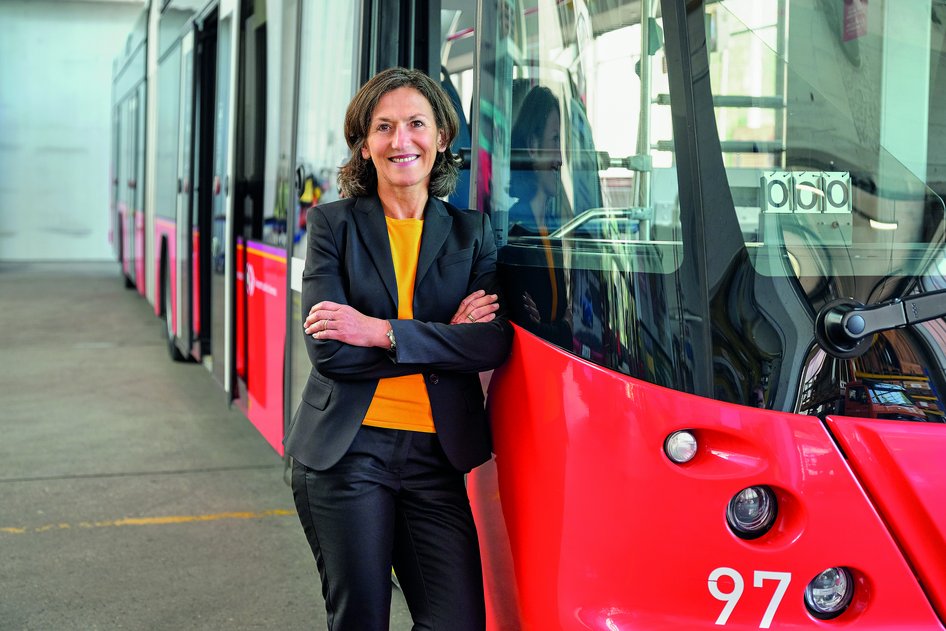
The shortage of skilled labour poses major chal lenges for many transport companies in Europe and makes it difficult to offer passengers a reliable service. How is Verkehrsbetrieben Biel tackling these challenges?
It is important to find new employees, but it is even more important to retain them. Attractive employ ment conditions are crucial for this. It is not only the salary that plays a role here, but also further training opportunities, holidays and loyalty bonuses.
Corporate culture is also essential; it characterises the way we treat each other and the way we work to gether. We have worked intensively on this in recent years and will continue to endeavour to strengthen our shared ‘DNA’. For example, we have integrated our values more strongly into our appraisals and pay particular attention to the ‘values fit’ of new hires. Managers are central to our corporate culture, which is why we have invested heavily in their training in re cent years.
We are also working on our image. We show how var ied and exciting our professions are. We emphasise that working in public transport is not only fun, but also meaningful.
Good communication, for example between driv ers and the control centre, is essential for smooth operations. Can digital solutions help to break down language barriers and thus support smooth operations?
In the event of an incident, such as an accident or traffic jam, personal communication between driv ers and the control centre is still the most important channel for us. Since the introduction of digital radio a few years ago, the quality has improved signifi cantly. But there is still the challenge of language – especially for us in Biel – with bilingualism. Digital solutions play an important role in providing cus tomer information in the event of a fault.
Text modules help with fault information and route suggestions for customers. The fully digital process for vehicle faults is particularly noteworthy: from re cording with standard texts and photos to forward ing to the workshop and ordering materials from the warehouse – everything is handled digitally. This helps to avoid errors and improve quality – and not just because of the language.
The mobility revolution is shaping change in the transport industry. What priorities do Verkehrsbe trieben Biel have for the next five years and what role will digitalisation play in this?
Digitalisation is of central importance to us. We have defined four priorities for this: firstly, Biel and the sur rounding agglomeration municipalities are planning a comprehensive expansion of services as part of the ‘Public Transport Concept 2035’. One of our priorities until 2027 is to help shape this in a customer-friendly and cost-effective way.
Secondly, we will electrify our entire bus fleet by 2031, with the first step being realised by 2027. This conversion will ensure the planned growth in supply. A modern fleet also opens up new technical and dig ital possibilities, such as driver assistance systems or continuous vehicle monitoring for proactive fault avoidance.
The third focus is a new depot for our larger vehicle fleet. We are planning a comprehensive energy man agement system there, taking into account our buses, cable cars and the use of second-life batteries. We are also thinking about automation processes, such as automated parking, to counteract the shortage of skilled labour.
We have digitalised a great deal in recent years, for example by introducing ERP, IVU.pad or Office 365. What is key here is that the new tools have to be used. The fourth focus is therefore on training our employ ees to get the best out of digitalisation.
We look forward to hearing from you
Do you want to talk with a customer advisor or learn more about career opportunities with us? Or maybe there is something else you want to talk to us about? Write to us – your contact person will get back in touch with you as quickly as possible.
IVU Traffic Technologies AG
Headquarters
Bundesallee 88
12161 Berlin, Germany
Phone: +49.30.8 59 06 -0
E-mail: contact@ivu.com
Stay up to date – receive news about our projects, customers, and products directly in your inbox.